


Immigration to Italy: How to Obtain Permanent Residence and Move in 2026
Permanent residence in Italy is a status that becomes available after 5 years of continuous...
 08.09.2026




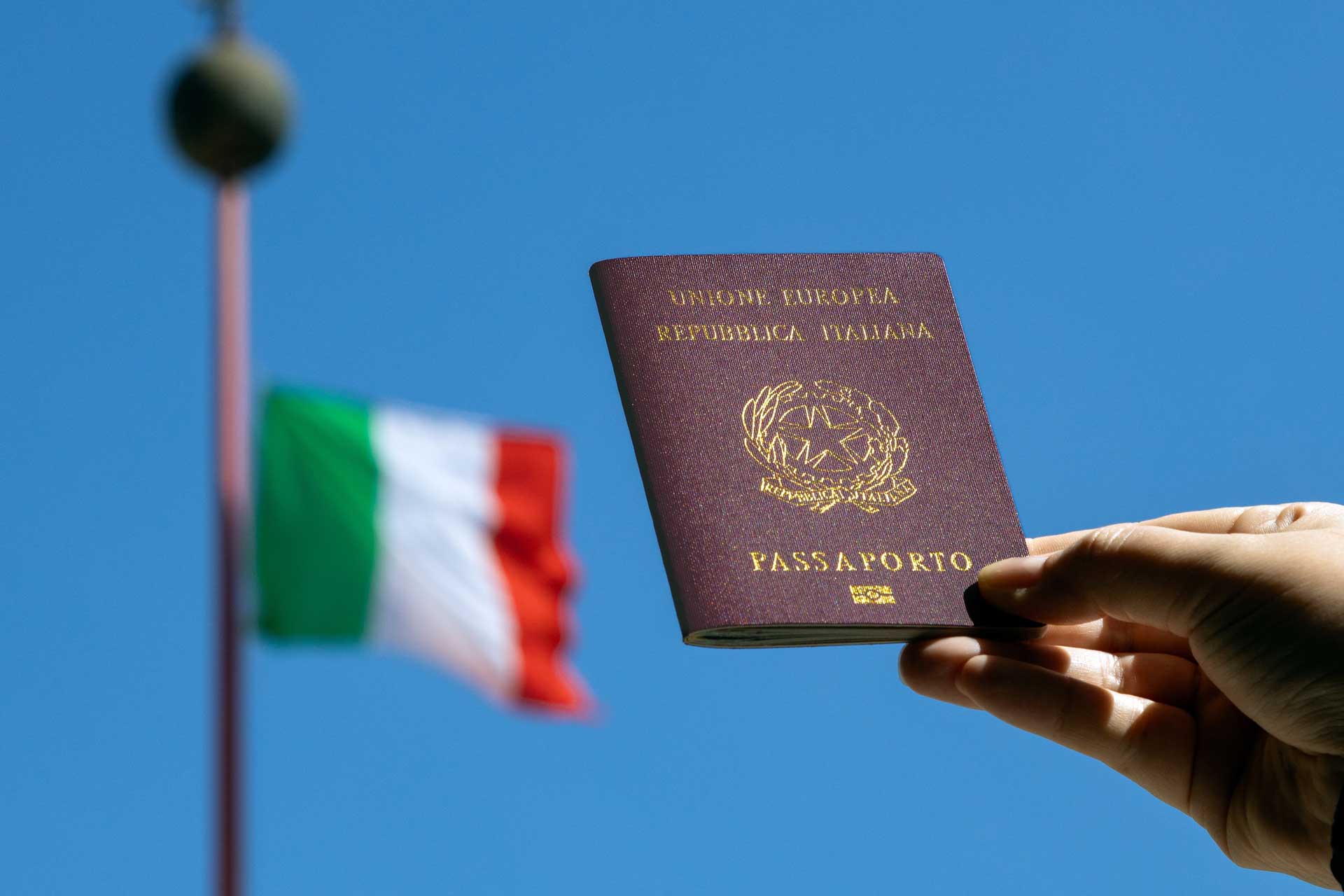
Italian citizenship may be obtained by foreigners who have legally lived in the country for 10 years or more and have demonstrated good character, financial stability, and respect for the national culture. Spouses of citizens are entitled to apply for status after just 2 years of marriage (when living together in Italy). If the couple lives abroad, the period increases to 3 years. The country also has a repatriation program for those who can prove direct Italian ancestry. There is no mandatory residence period for this category. Purchasing real estate, giving birth in the country, or investing in economic development does not entitle a person to citizenship.
Every year, the state approves tens of thousands of applications. However, obtaining a passport requires proof of an impeccable tax record with a minimum annual income of EUR 8,263 per person, no problems with the law, and a certificate confirming knowledge of Italian at no lower than B1 level. The Ministry of the Interior may take from 24 to 36 months to process the documents.
The basis of Italian immigration law is the Consolidated Immigration Act, Testo Unico sull’Immigrazione — Legislative Decree No. 286. The document regulates the entry and conditions of stay of foreign nationals. Matters concerning the acquisition of a passport are governed by Citizenship Law No. 91/1992. The basic acts are continually supplemented by packages of government amendments. In 2026, for example, the most significant changes concerned two aspects: work-visa quotas and the rules for obtaining status.
Previously, to participate in the repatriation program it was possible to prove the existence of an Italian ancestor even in the fourth or fifth generation. Under the new requirements, citizenship may be claimed only by those whose parent or grandparent was an Italian citizen.
The rules for the automatic transmission of citizenship to children born outside the country have changed. Italian parents are now required to submit a special declaration within one year of the child’s birth. The law set a deadline of 31 May 2026 for registering children who missed this period. If the parents fail to do so, the child will have to live in Italy for 2 years in order to obtain a passport.
Italy continues to implement its three-year plan for attracting foreign workers, but it sets quotas (nulla osta) for legal entry. In accordance with government decrees, 164,850 foreign nationals will be able to obtain legal work authorization in 2026.
Italian legislation provides for several ways to obtain a passport:
For the Prefecture to accept an application for consideration, the following criteria must be met:
The application is submitted online through the Ministry of the Interior’s specialized portal (ALI) using an SPID digital identity or a CIE electronic identity card.
The basic documents required when applying for citizenship include:
The Italian passport consistently ranks among the world’s top five strongest passports, but immigration is not suitable for everyone. Alternative options are worth considering if you are not prepared to wait 12–13 years, have unstable income, or find foreign languages difficult.
Italy allows second or dual citizenship. However, if your country requires you to renounce your passport when acquiring a new one, the lengthy naturalization process may lose its appeal. An experienced immigration lawyer from the company, who has up-to-date information about EU immigration programs, can help you make the right choice based on your individual situation.
If there is no Italian ancestor in your family, the fastest way to obtain Italian citizenship is through marriage, especially if there are children. Naturalization requires at least 10 years of residence. Citizenship by residence requires proof of stable official income for the last 3 years; there is no such requirement for spouses. However, both marriage and naturalization require a B1 certificate. By contrast, no exam is required for direct confirmation of descent if you meet the requirements of “right of blood.” It is not possible to become an Italian citizen:
Repatriation to Italy is a process through which a person born in another country restores or confirms status on the basis that their ancestors were Italian. The program is suitable for people whose parents or grandparents were Italian citizens. If your Italian ancestors are beyond the second generation (great-grandparents and further), the automatic route by blood is closed to you. Exceptions apply to those who managed to submit a complete set of documents or obtain a confirmed consular appointment before 27 March 2025.
In 2026, taking the new amendments into account, to obtain a passport through repatriation, a mother/father or grandmother/grandfather must have been born in Italy and held Italian citizenship. It is important that the ancestors did not voluntarily renounce Italian citizenship before the birth of the next child in the line. If direct repatriation by descent is impossible, the new laws offer alternatives:
Investor Visa for Italy is a government immigration program created to attract substantial foreign capital into the economy. The program provides for verification of the legality of funds and preliminary approval of the investment. The capital must be invested within 3 months after entry and submission of residence permit documents. This is the only type of residence permit that is not cancelled if you spend more than 6 months a year outside the country. Residence rights are granted through investment in one of four areas:
A visa and a 2-year residence permit are issued first. If the investment is maintained in full after 2 years, the residence permit is extended for 3 years. After 5 years, permanent residence becomes available, and after another 5 years the applicant may apply for an Italian passport.
Standard naturalization is an option for foreigners who do not have Italian roots or substantial capital for investment. A passport is granted on the basis of long-term continuous residence in the country, integration into society, and regular payment of taxes. The required residence period before application depends on the applicant’s initial status:
For spouses, the residence requirement is 2 years, provided the husband and wife live in Italy. If they reside abroad, the minimum period increases to 3 years; having common children reduces the required period by half in both cases. If a foreign national was born in Italy but did not obtain citizenship at the age of 18, they may apply for naturalization under an accelerated procedure after 3 years of official residence. A summary of the residence requirements and Italian citizenship fees for each category is presented in the table below.
| Applicant category | Required residence period | Total fees, EUR |
| Citizens of non-EU countries | 10 years | 266 (fee 250 + stamp 16) |
| Citizens of the European Union | 4 years | 266 (fee 250 + stamp 16) |
| Refugees/stateless persons | 5 years | 266 (fee 250 + stamp 16) |
| Adult foreigners adopted by Italians | 5 years | 266 (fee 250 + stamp 16) |
| Persons born in Italy | 3 years | 266 (fee 250 + stamp 16) |
| Direct repatriation | — | 600 (fee 600 + stamp 16) |
The final cost will be higher because it includes obtaining criminal record certificates in the country of origin or previous residence, the services of an Italian sworn translator, and taking the B1 language exam (approximately EUR 100–150 if you do not already have a certificate).
The residence requirement can be fulfilled after obtaining a residence permit (Permesso di soggiorno). The type and conditions of stay for each basis differ and affect the prospects for obtaining permanent residence:
To obtain Italian citizenship, it is necessary to obtain temporary and permanent residence permits step by step and provide evidence of knowledge of the national language and stable income for living expenses. The procedure is standard for everyone who obtains status other than through repatriation:
The competent Italian authorities may reject an application for one of the following reasons:
If a problem is identified, the Prefecture sends a Preavviso di rigetto (pre-notice of refusal). From the moment it is received, you have 10 days to provide missing certificates or prove that the situation has been corrected. If this is not done, a final refusal will be issued, which can only be challenged in court within 60 days.
An Italian passport may be lost if it is established that the status was acquired on the basis of forged documents. Cooperation with terrorist organizations, espionage, or actions deemed hostile to Italy by the security services may also constitute grounds for deprivation of citizenship. Challenging such a decision is extremely difficult — claims are filed with higher courts and the European Court of Human Rights with no defined processing period.
An Italian passport provides the right to:
The citizenship process also has disadvantages. According to reviews, processing applications takes considerable time and involves bureaucratic procedures. It should also be taken into account that if you plan to live permanently in Italy, you will face a progressive tax scale with rates of up to 43% on worldwide income.
The Italian government does not initiate notification of other countries when issuing a passport and, under Article 11 of the law, officially allows second citizenship. When obtaining an Italian passport, you will not have to renounce the citizenship you already hold. An exception applies where the applicant’s home country prohibits acquisition of another legal status. Dual citizenship based on signed agreements on mutual recognition of rights and obligations is possible only for citizens of Argentina and Nicaragua.
An analysis of immigrant cases makes it possible to identify the main features of the Italian passport application process. Complaints include reports that the service often freezes and application statuses do not change. Processing speed depends on the region. In small municipalities in northern Italy, the procedure may take 12–18 months. In Rome, Milan, or Naples, applicants often wait 2–3 years for a decision because of the enormous volume of applications.
Examining immigrants’ experiences highlights points that deserve particular attention. For example, a criminal record certificate must be recent at the time of filing. Many applicants fail to account for the time needed for apostille and translation, upload a certificate that is more than six months old, and receive a refusal during processing because the document has expired.
If the statutory processing period is nearing its end and the status has not changed, sending an official letter by certified mail may produce results. Apply for the B1 certificate in advance — the exam and waiting for the certificate itself take from 2 to 4 months. Have translations done by accredited translators.
Assistance with obtaining Italian citizenship can save time and effort. If state authorities violate document-processing deadlines, an independently filed complaint is often ignored. A lawyer sends not merely a letter, but a formal demand to remedy the violation through certified mail. The request is supported by legal provisions. In most cases, the Prefecture prefers to resolve the issues in order to avoid future litigation costs.
If your dossier falls even one hundred euros short of the annual income requirement, an old fine is discovered, or there is a gap in your residence registration, you will receive a notice under Article 10-bis of Law 241/1990. You have exactly 10 days to file an appeal and challenge the arguments. During this time, a person without legal experience will not be able to substantiate, for example, why their income fell temporarily for reasons beyond their control or why the Prefecture incorrectly calculated continuity of residence. If the Prefecture issues a final refusal, it is no longer possible to correct the situation administratively.
Consulting an immigration lawyer is a tool for ensuring that the state complies with its own laws. A lawyer saves you money by protecting you from having to start the process again because of your own or a bureaucratic error.
Foreign nationals can become Italian citizens without residence if they have direct-line Italian ancestors (father, mother, grandfather, etc.) who did not renounce their citizenship before the birth of their children. Documents may be filed through the consulate in your country.
Yes. For most categories, citizenship requires a certificate confirming knowledge of Italian at no lower than B1 level. An exception may be made for applicants holding EU long-term permanent residence issued before the new rules were introduced, or those who graduated from an Italian school or university. Applicants obtaining a passport by “right of blood” are also exempt from the exam.
Italian legislation fully allows multiple passports. Italy does not require you to renounce your previous citizenship when obtaining an Italian passport.
The standard residence requirement for citizens of non-EU countries is 10 years of continuous lawful residence with registration. For citizens of European Union countries, this period is reduced to 4 years; for refugees — to 5 years.
If you obtain Italian citizenship, your minor children (under 18) who live with you at the time you take the oath may obtain an Italian passport together with you. If the children have already reached adulthood by that time, they will have to follow their own naturalization route, but under a simplified procedure (for children of former foreign nationals who became Italian citizens, the residence requirement is reduced to 5 years).

Ability to do business and work in the EU without restrictions
Study in European universities with the civil rights
Visa-free travel to more than 160 countries around the world
Full access to the freedoms and guarantees established for EU citizens